
How to Build an Effective B2B Sales Funnel with Digital Storytelling

Overview – Combating Buyer Friction in the B2B Sales Funnel
The way organisations purchase technology and services has fundamentally changed. Today’s buyers delay direct interaction with sales reps until they are 80% to 90% of the way through their own decision-making process before they acknowledge their presence in the B2B sales funnel.
This shift creates a new buying “tipping point”: prospects independently diagnose their operational symptoms, research potential solutions online, assemble vendor shortlists, and build internal consensus, all before ever reaching out to your sales team directly.
To win in this environment, B2B companies must adapt, you need a high-converting go-to-market engine that pairs Digital Storytelling (to build emotional trust during the self-research process) with a modern Funnel Strategy (to convert that self-directed attention into qualified pipeline).
The reality of today’s “self-directed” B2B Buying Journey in the sales funnel
The modern buying committee no longer relies on vendor sales reps for information. Research from leading B2B intelligence firms highlights the scale of this shift:
- Over 70% of B2B buying committee members and researchers are digital-native Millennials and Gen Z (Forrester B2B Buying Survey). According to Gartner, over 75% of buyers now actively prefer a “rep-free” buying experience, viewing early sales outreach as a high-friction distraction rather than a helpful resource.
- 6sense reports that 83% of the buyer journey happens anonymously. Furthermore, Gartner data reveals that buyers spend only 5% of their total purchase time meeting with sales reps.
- Research from 6sense, SurveyMonkey, and Forrester shows that 83% to 89% of B2B decision-makers define their requirements and shortlist vendors through self-guided research before initiating vendor contact.
- TrustRadius and Forrester indicate that over 80% of B2B buyers now leverage AI tools (such as ChatGPT, Perplexity, and AI Search Overviews) to synthesize vendor options incognito.
Historically, vendors held an information monopoly, they were the gate keepers. Today, information asymmetry has flipped. Buyers evaluate you through their peers, review platforms (like G2 and TrustRadius), and AI search engines, long before you know they exist.
Your digital content is now your sales team for the first 80% of your prospects buying journey.
What Is The Value Of Having a B2B Sales Funnel?
Typically a prospect or visitor to your website won’t buy from you at first glance, it takes time to establish a level of trust and authority. The B2B sales funnel lays down the journey as the relationship evolves between the buyer and the seller.
The chart below shows the buying journey (from Awareness to Decision) that your B2B sales prospects theoretically take. They go from realising that they have a problem right through to shortlisting vendors and making a purchase.
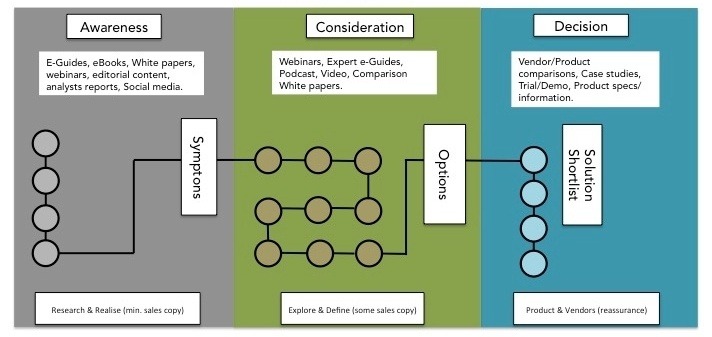
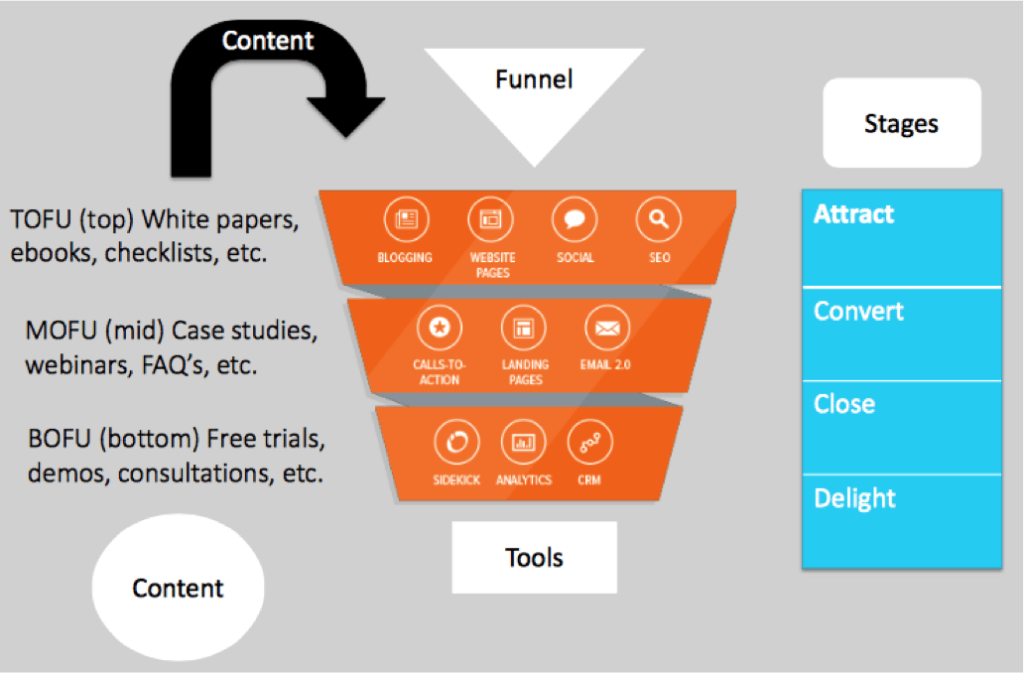
A funnel visualises the journey and helps you apply your marketing and sales efforts accordingly. For example, don’t talk about product features at the beginning of your relationship when visitors aren’t familiar with your brand or products or don’t realise that they actually have a need.
Read more here on funnels.
The 4-Part Growth Engine: From Buyer Intelligence to B2B Funnel Strategy
Connecting Top-of-Funnel (TOFU) attraction with Middle/Bottom-of-Funnel (MOFU/BOFU) conversion addresses a big flaw in B2B marketing: stories that attract attention but fail to convert and generate revenue.
To understand the story you need to tell starts with uncovering Buyer Intelligence, unfiltered insights into why buyers seek your solution over and above others or if they hesitate, what are the blockages?
You can gather this information by interviewing buyers, analysing your own sales pipeline data and seek out information that uncovers the real human triggers, fears, decision criteria, and buying committee dynamics.
You will need to build a growth engine that simultaneously delivers on attraction and conversion, combining the 4 pillars across storytelling and funnel conversion:
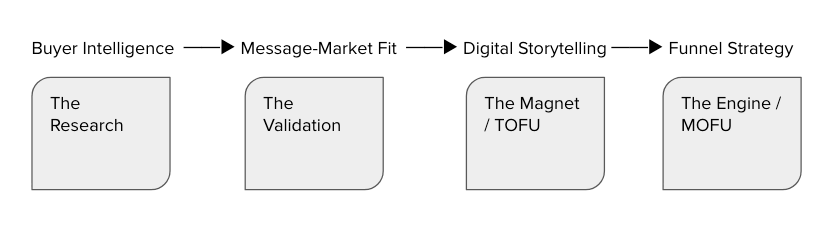
Pillar 1: Uncover Buyer Intelligence
Buyer Intelligence asks five fundamental questions about how purchasing decisions actually happen to reveal the hurdles your prospects navigate during self-guided research:
- Priority Triggers: What internal or external event forced them to look for a solution now?
- Success Factors: What operational or financial outcomes define a win?
- Perceived Barriers: What fears, risks, or legacy systems make them hesitate?
- Decision Criteria: Which specific capabilities dictate the final shortlist?
- Journey Mechanics: Who sits on the buying committee, and how do they evaluate options behind closed doors?
Translating these buyer insights into positioning hypotheses means you have something to A/B test across landing pages, ads, and campaigns. You refine the messaging until you get the right Message-Market Fit, a narrative that resonates with your target audience and dissolves buyer skepticism.
Pillar 2: Validate Message-Market Fit
Message-Market Fit measures whether target buyers understand and act on your messaging.
With a validated message, you can craft engaging content. You now have a blueprint for a digital story that mirrors the buyer’s internal struggle. It’s this alignment that reframes their personal risk, and earns their trust while they conduct ongoing self-research.
Message-Market Fit can be measured quantitatively (visitor-to-lead ratios, ad CTRs, hero page dwell times, pipeline velocity) and qualitatively listening to your prospects to see
Finally, you have your “hook” embed your digital storytelling into a structured, low-friction, buying journey. You map clear pathways with self-service assets that hopefully compel your audience to act.
Pillar 3: Humanize your Digital Storytelling
B2B offerings are often dense, technical, and jargon-heavy. Prospects abandon early content when they cannot immediately grasp how a solution solves their day-to-day problems.
MOFU bridge building takes the core themes of your storytelling and anchors them with risk-reducing proof and practical examples. By framing messaging around emotional drivers such as fear of career damage, team burnout from inefficient systems, storytelling bridges the trust gap. When a buyer sees their operational realities mirrored in your narrative, they shift from passive reading to active trust as they begin to see a step-by-step path from their current state to the promised outcome.
Pillar 4: Architect the Funnel Strategy (MOFU & BOFU)
While storytelling addresses the person and creates the initial pull, funnel strategy builds the operational architecture that converts that attention into pipeline.
Buyer Intelligence and Message-Market Fit form the foundational layer that makes Digital Storytelling persuasive and Funnel Strategy effective.
In an era where buyers conduct extensive self-guided research before ever speaking to sales, achieving this alignment ensures your core story cuts through the market noise rather than getting filtered out as generic vendor spin.
Why Deals Stall at MOFU (And How to Fix It)
The Middle of the Funnel (MOFU) is where most B2B sales stall, not because buyers choose a competitor, but because of internal friction, fear of change, and risk aversion.
With the number of stakeholders involved in the buying process growing and all with different agendas, it becomes the responsibility of the internal “buyer champion” to take on the initial self-research. They gather digital content, ROI calculators, and case studies to build consensus and justify the initiative internally before inviting a vendor to the table. So, by arming the internal champion with self-service tools they can present and defend your solution to their internal buying committee.
While TOFU storytelling hooks the reader, MOFU transforms emotional interest into commercial evaluation by presenting a step-by-step path from where the buyer is today to the promised outcome, eliminating fear and replacing uncertainty with proof of results.
Read more on funnels.
Re-imagining the B2B Sales Funnel for a Non-Linear World
Traditional sales models view the funnel as a rigid, linear assembly line. In reality, modern B2B buyers enter, exit, skip stages, re-engage, and move fluidly across devices and channels.
A common mistake is assuming that if a visitor doesn’t immediately request a demo, they have abandoned the purchase. In truth, buyers are taking their time, evaluating risk behind the scenes.
To capture non-linear demand, your Funnel Strategy must build context-aware pathways:
- Offer Micro-Conversions: A TOFU reader isn’t ready for a “Book a Demo” button. Offer a 1-page checklist or diagnostic canvas at TOFU, an interactive ROI tool or comparison matrix at MOFU, and an architecture audit at BOFU.
- Remove Operational Friction Systematically: Place self-service pricing details, technical implementation guides, and security documentation directly in the buyer’s path before hesitation kills the deal.
- Deploy Intent-Driven Nurturing: Track engagement signals (content downloads, tool interactions, key page visits) to trigger contextual follow-ups, ensuring sales reps step in only when the buyer demonstrates high intent.

Transforming Your B2B Growth Engine
Winning the modern B2B buyer requires abandoning outdated outbound playbooks that force early sales calls on unprepared prospects.
To convert today’s self-educating buyer, organisations must unite Digital Storytelling (anchored in real customer truths) with an accessible, non-linear Funnel Strategy (engineered to remove operational risk). When you ground your narrative in validated Buyer Intelligence and Message-Market Fit, your marketing stops feeling like vendor spin and starts building pipeline.
To convert today’s buyer, companies must build Digital Storytelling anchored in authentic customer experiences and deliver it through an accessible, non-linear Funnel Strategy. Digital Storytelling creates the initial pull, but MOFU Funnel Strategy map and removes friction so prospects can safely cross the bridge from interested readers to qualified pipeline opportunities.
Ready to Transform Your B2B Buyer Journey?
We help B2B companies uncover deep buyer insights, craft high-converting digital narratives, and architect non-linear funnels that drive predictable pipeline.
Let us conduct a strategic audit of your end-to-end marketing funnel, reach out to John today.
