
The 2025 E-commerce Rebound: From Recovery to a New Normal.
Overview
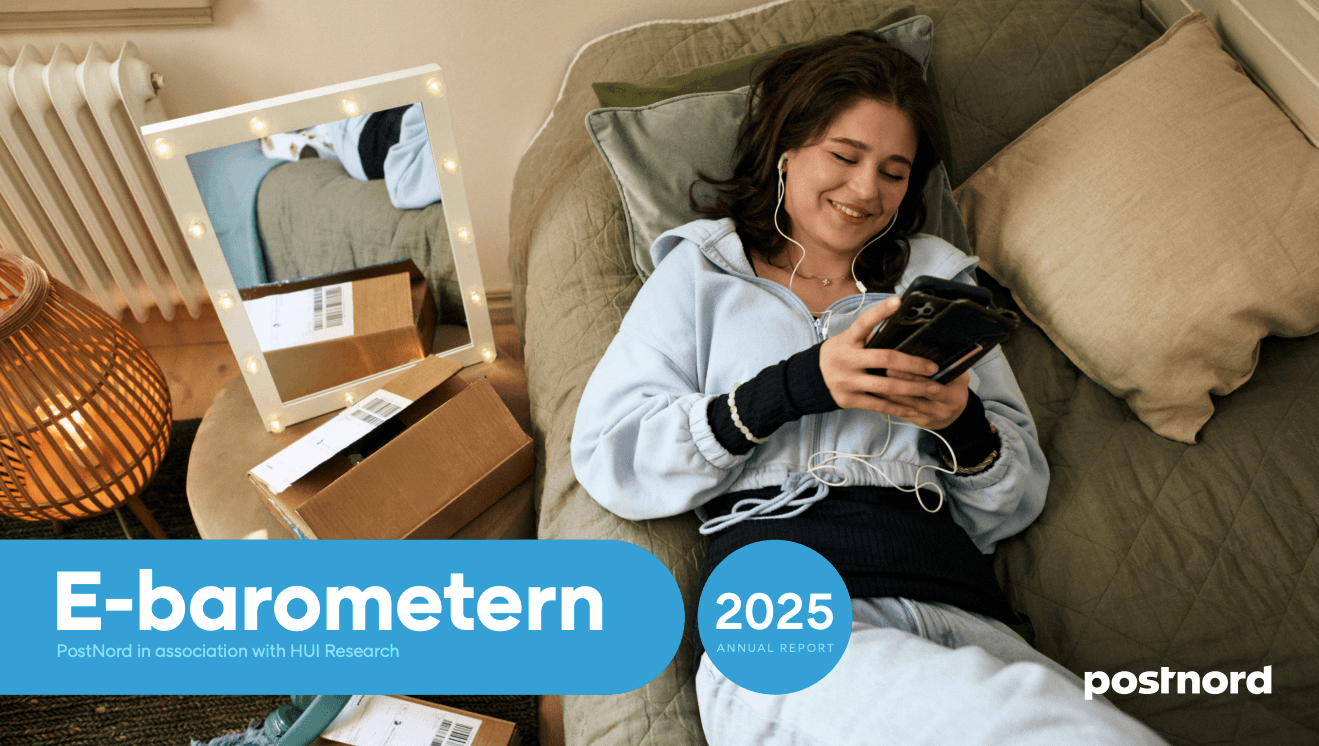
The latest findings from the PostNord E-barometer Annual Report 2025 in association with HUI Research point to strong recovery in Swedish e-commerce. Total online spend reached SEK 153 billion, representing 10% year-on-year growth and surpassing the previous peak of 2021.
After several years of economic uncertainty and inflation it seems Swedish consumers have regained their purchasing power, reflected in the increase of online shopping.
For e-commerce leaders, the challenge for 2026 is no longer about simply “recovering” lost ground from the high of 2021. It is about competing in a more complex, fragmented, and bullish e-commerce environment.
Online sales not only showed positive growth in 2025, they also grew at a faster rate than retail as a whole, as e-commerce sales grow it continues to take market share from physical stores, who must reflect on what actions they can take to address these challenges.
After several years of dominating the e-commerce top spot in terms of growth, pharmacies have now been joined by furniture and home furnishings, with both sectors achieving full-year growth of 18 percent.
At the other end of the scale are books and media, which had the weakest performance, with a decline of three percent. The remaining e-commerce sectors grew by at least five percent,
The New Rules of the Game
The PostNord E-Barometer Annual Report highlighted a number of trends that changed the business landscape in 2025.
The growth of Social Commerce – with social media playing an increasing role in the e-commerce market. Although more than eight out of ten Swedish consumers have not yet made a direct purchase via social media, it remains an untapped channel.
The rise of the circular economy – in particular the purchase of second-hand clothes has gone mainstream.
The breakthrough of AI in 2025 – with half of all consumers now using AI in their research phase in the customer journey. The question isn’t whether you should use AI, but how you’re making your products “discoverable” to the AI agents your customers are already using.
Omnichannel: The Battle for Market Share
Approximately one-third of consumers regularly utilise multiple channels within a single purchase journey. It is now standard behaviour to find inspiration on a smartphone, view the product in-store, and ultimately complete the purchase online after price comparisons.
For retailers, success depends on seamless channel switching. If your digital and physical experiences are siloed, you’re failing the consumer’s need for fluidity as they channel shift.
Businesses going forward need to focus on how to bridge any perceived gap between the online and in-person experience, treating physical touchpoints as high-value “brand discovery” opportunities that feed into a sophisticated digital fulfillment funnel, reducing friction between discovery and transaction touch points.
Physical “bricks-and-mortar” stores and e-commerce meet different needs, at least to some extent. Digital channels are increasingly responsible for availability and convenience, while physical stores continue to play an important role in the customer experience.
Modern Swedish consumer behaviour is inherently hybrid.
The 2025 data confirms that digital and physical channels no longer compete; they complement. Moving seamlessly between digital and physical environments within a single purchase journey is particularly prevalent among high-frequency shoppers, those who recognise that switching channels allows them to optimise primarily for price – to “price shop”, to some extent search out product availability, and may be seek inspiration.
The fluidity in this journey is not just a consumer preference; it is a revenue driver. Industry analysis highlights that omnichannel customers are demonstrably more valuable, spending approximately 1.7 times more than single-channel users.
Success in 2026 depends on enabling continuity, not just presence, across multiple touchpoints.
The AI Paradox: Utility vs. Control: Navigating the Trust Gap
AI evolved in 2025 from an experimental tool to a core component of e-commerce operations. However, its adoption is marked by a clear paradox: technology use is spreading, but consumer trust is lagging.
The share of consumers using AI agents like ChatGPT, Gemini, or Copilot to find products doubled in a single year, reaching 20%. However, this technological leap is met with a notable “trust constraint.”
While consumers find immense value in AI during the “discovery and research” phase, using it as an intelligent shortcut to filter complex options in sectors like home electronics or fashion, there is significant resistance to full automation.
Over half of consumers remain against an AI agent managing the entire process through to purchase.Concerns regarding disinformation, fraud, and a loss of personal control are primary barriers.
The strategic priority for 2026 is twofold: first, optimising your “AI-readiness” by structuring product data for machine readability (feeds, schemas, and APIs); and second, building a “trust architecture.” Brands must position AI as decision support, not a decision replacement, maintaining transparency in how recommendations are generated to ensure the consumer feels in control.
What Consumers Want
- Early-Stage Value: Consumers find AI most useful in the “inspiration and research” phases (e.g., filtering products, simplifying searches).
- Sector Specificity: AI is most welcomed in complex categories like Home Electronics (where technical specs are difficult to navigate) or Fashion (for size and style guides).
What Consumers Fear
- Security & Manipulation: Significant concerns remain regarding fraud, disinformation, and the potential for AI to manipulate decision-making.
The Strategic Priorities for 2026
To compete effectively in this environment, organisations must focus on:
- End-to-end visibility: Move beyond channel-level optimisation to full customer lifecycle management
- AI readiness: Ensure products and content are accessible within AI-driven discovery environments
- Trust architecture: Build transparency into data usage and AI interactions
- First-party data maturity: Strengthen CRM and data infrastructure to reduce dependency on external platforms
- Map the Big Picture: Move beyond campaign-level thinking to understand the entire customer lifecycle.
- Optimise for the AI Research Phase: Ensure your product data is structured for the 20% of consumers (and growing) using AI to find you.
- Bridge the Trust Gap: Build transparency into your AI-driven recommendations to maintain consumer control.
Let us conduct a strategic audit of your end-to-end marketing funnel, reachout to John today.
